
For NGOs, community lenders and social enterprises
We piloted store credit starting at $2, paid straight to the store.
In Metro Manila, customers bought on credit at stores that knew them. Now we are looking for advice and for an NGO or community lender for a first US pilot.
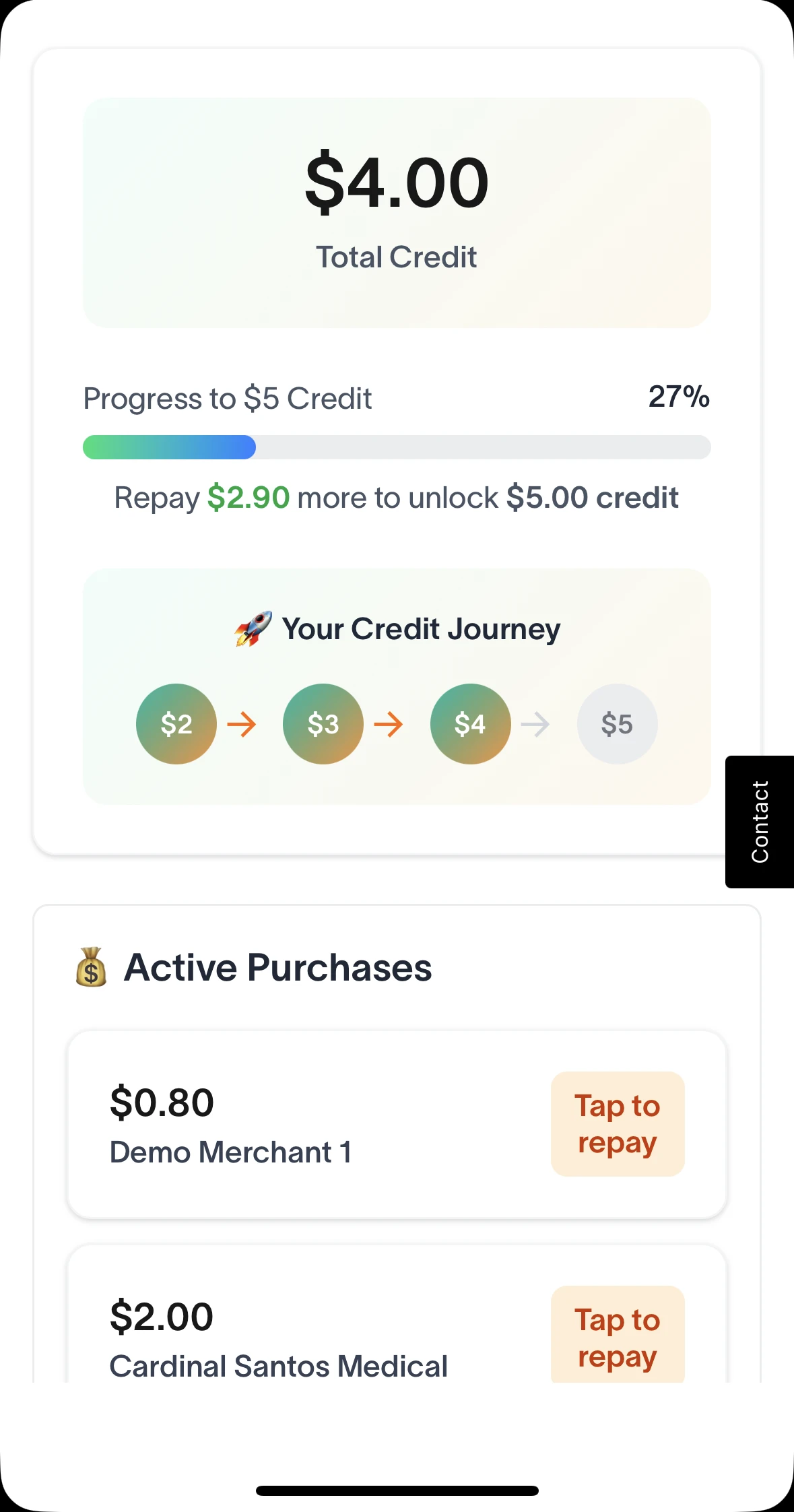
The pilot app
Watch one credit, from the counter to repayment
Most of the cost of a credit is fixed. At a few dollars, that cost is bigger than the credit itself. In the pilot app, software did the approval and the bookkeeping.
Credit and repayment in the pilot app
38 seconds, no sound. Pick a store, ask for $2, verify, then repay.
Screen recording of the pilot build (Manila 2025) with demo data. The wording in the app, including “loan”, is from that build. The limits shown are not pilot limits.
Verify as one real person
One person, one account. In the pilot this was World ID. For the US we are looking at other identity checks.
Credit at the counter
In the pilot, software approved a purchase at a store that knew the customer. The limit grew with each repayment.
Money goes to the store
The customer never handles cash.
Repay in the app
The pilot build charged interest, capped at 50% a year. The US design: 0%, no fee for the customer.
September 13 to 19, 2025
A one-week pilot in Metro Manila
- week
- 1
- stores
- 3
- transactions
- 28
- customers
- 23
The first credit limit was $2.50. It grew with every repayment, up to $5.
Shown
The flow works at the counter.
Not shown
How many customers repay over time. One week is too short for repayment data.
Since the pilot week
Testing the market in the Philippines was stopped short because of a regulatory action against the identity provider (not against NanoCredit). The pilot depended on that one provider.
What happened if a customer did not repay?
Nobody called or visited. The account stayed locked for new credit. The loss fell on a pool funded by one of the founders, with exposure capped at $5 per person. The store had already been paid.
Since October 2026
From pilot to pivot
In Manila our credit competed with “five‑six,” the informal rule: $3 today, $3.60 next week, 20% in a week. In Oakland, CA we are exploring the potential to test and pilot in neighborhood corner stores, to enable access to fruits and vegetables year-round at prices communities can afford.
Oakland field work
17 corner stores, interviewed in person.
Infrastructure for institutions
NGOs, community lenders and credit unions would run their own programs on it. The institution would pay per transaction. The customer would pay nothing. Open: who funds the credit, who carries defaults.
NanoProof: a reputation record you own
Each repaid credit would add an entry to the customer's own record, which they could take to a credit union. Positive history only: nothing negative would be written. This is not a credit bureau.
Two routes to a first US pilot
Route A: Start with the customers (people)
An NGO or community lender that already knows and trusts the people at the counter. Philanthropy would cover the cost of reaching them.
Open: timing, and who does the technical work.
Route B: Start with the identity check (provider)
A commercial provider of identity checks (KYC), at low cost and in large numbers.
Open: who brings the customers.
Which would you test first, and what would you want to see before you believe it?
Tell us in a 30-minute callA first US pilot
For partners
You bring
Communities and customers you already know, and a program you want to test. It could be a store, a lending circle, or a community credit pool that already works as an informal economy.
We bring
The pilot app as the starting point. A US version, including store sign-up, payouts and the identity check, is not yet built. NanoCredit is the technology provider.
Open for both of us
Who funds the credit and who carries defaults. The price per transaction is open too. Our starting assumption: the credit is legally extended by the partner (lender of record).
Team
Two founders, no employees, both alongside other roles.

Alexander Schmitt
Co-Founder · Technology
Berlin
At NanoCredit he builds the app and ran the Manila pilot. CTO at Leondrino, a regulated Berlin fintech.
Alexander Schmitt on LinkedIn (opens in a new tab)
Erin O'Brien
Co-Founder · Revenue & Partnerships
San Francisco Bay Area
At NanoCredit she runs revenue operations and partnerships, leads U.S. field work, and designs global implementation opportunities. Formerly at CARE, Kiva, Fair Trade USA, and Grameen Technology Center.
Erin O'Brien on LinkedIn (opens in a new tab)
Advisor
Kevin O'Brien
Advisor · San Francisco
CTO of Doc2Doc Lending, formerly CTO of Kiva and of Fairbanc (closed-loop financing for micro-merchants in Southeast Asia). Building on Ethereum since 2016.
Kevin O'Brien on LinkedIn (opens in a new tab)Talk to the founders
Thirty minutes, no deck required. Alexander takes the first call and brings in Erin for partner and pilot questions.