
How NanoCredit works
A customer at a small store gets a few dollars of credit on their phone. The store is paid at once, in USDC, on World Chain. The customer takes the goods and repays through the app. World ID makes sure every account is one real person. No cash changes hands.
What we ran in Metro Manila, September 2025
One pilot week, three stores, on World Chain mainnet. The screens below are from the pilot app, with the amounts that ran that week.
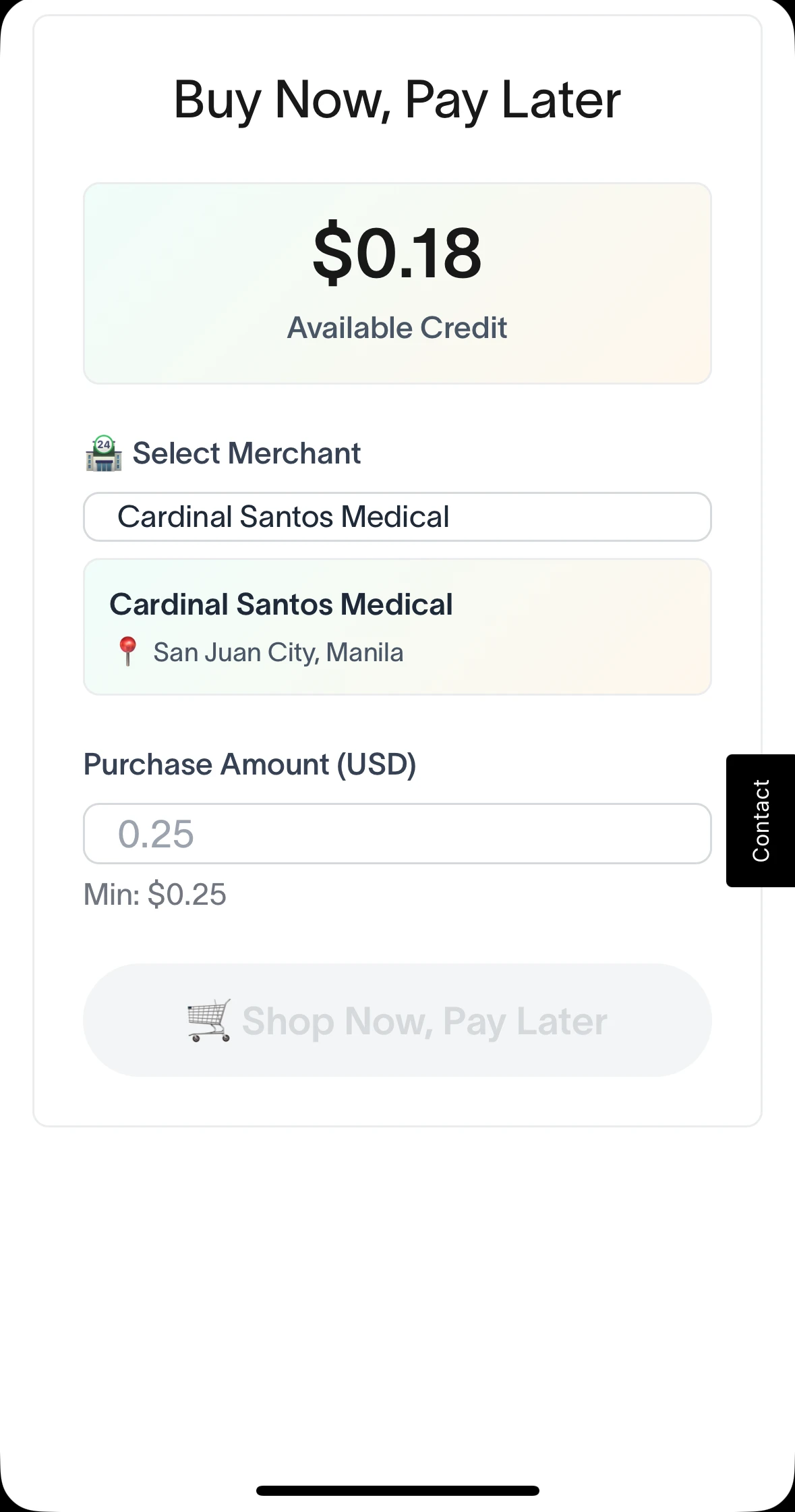
Request credit at the store
At the counter the customer opens the app, picks the store and types the amount. Requests start at $0.25. World ID has already confirmed that this person is unique, so there is no form and no score. The first credit line is $2.50.
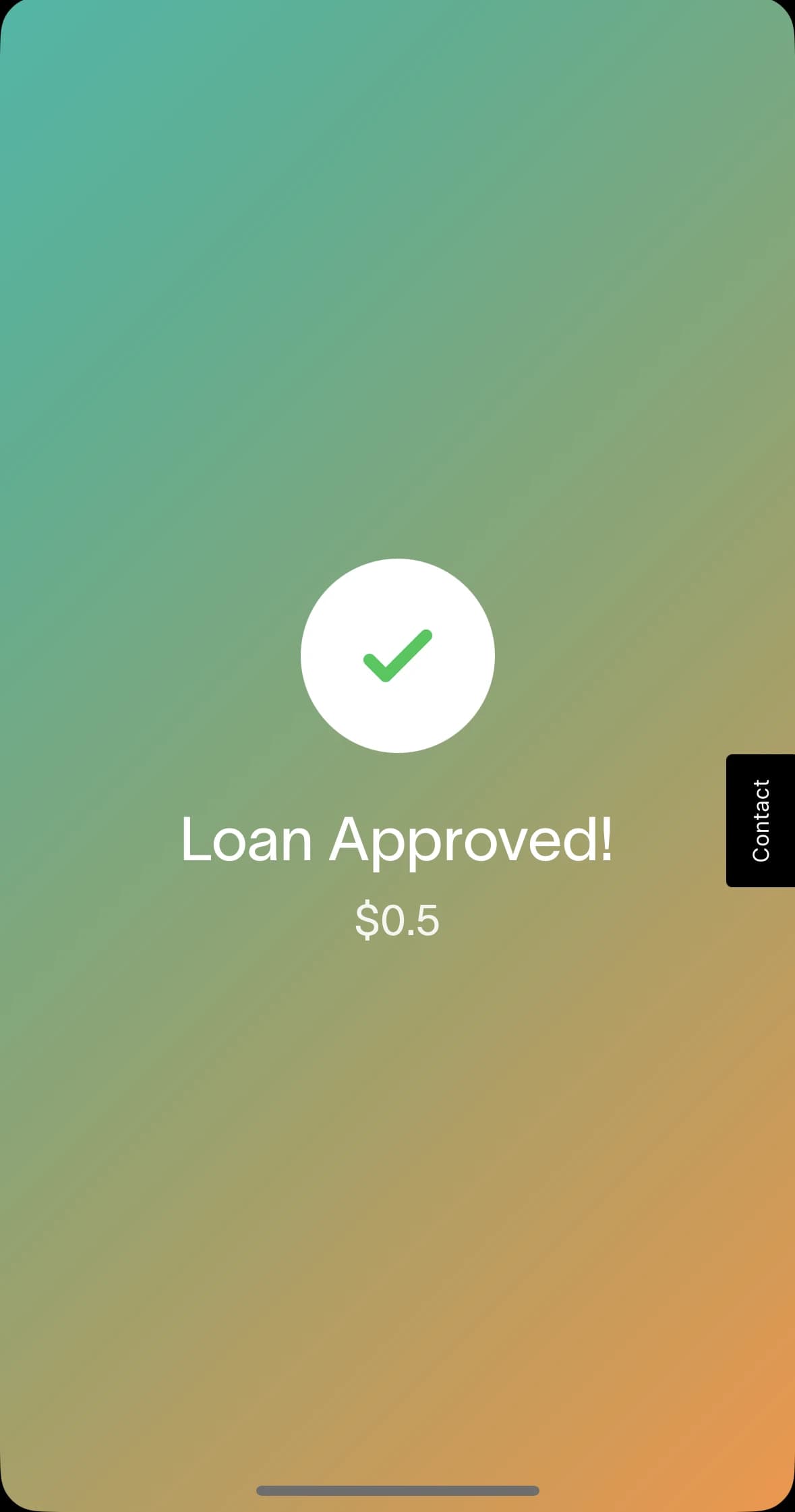
Instant payment to the merchant
The contract approves within seconds and pays the store in USDC. On this screen: $0.50. The customer never holds the money, they hold the goods. Nothing to cash out.
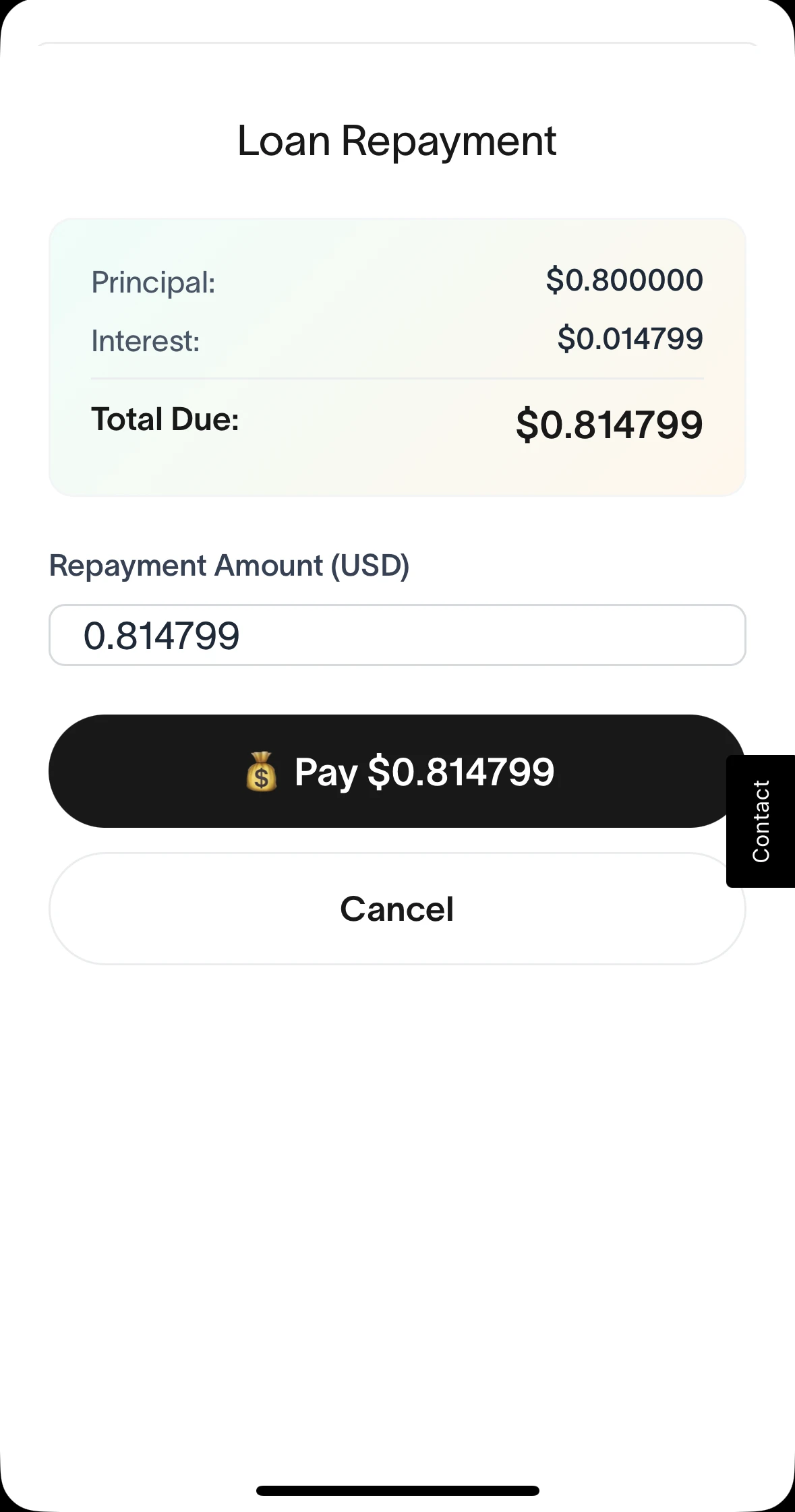
Repay
Repayment happens in the same app, when the customer has the money. Here: $0.80 plus about one cent of interest after roughly two weeks. Every repayment raises the limit by $1, up to $5 in the pilot. The next phase takes it to $25.
Next: the same flow at an almacén in Buenos Aires, settled in USDC via World's QR network.
Argentina is the next pilot market, in preparation. The Philippines pilot ran as planned. A regulatory action against the identity provider in the Philippines (not against NanoCredit) paused the market.
The problem
$3 today, $3.60 next week
Informal credit in Metro Manila runs on a rule everyone knows as five-six: goods worth five today, six back next week. Take a ₱150 basket, about $3. Next week it costs $3.60. Twenty percent a week, and the week after it starts again. Over a year that is more than 800 %.
Most people pay it, because the alternative is going home without the rice.
Twenty-nine seconds from the founder interview, the five-six rule in his own words.
From the founder
Five, six: what informal credit really costs
The informal standard in the Philippines. You get $5 of products today and pay $6 next week. Annualised that is more than 800 percent.
The mechanism
Trust by default, once
Every verified person gets credit on day one. Nobody checks a score, because there is none. The rules that make this hold are written into the contract.
No due date
The customer repays when the money is there. Next day or next month, the contract does not chase.
Interest stops after 12 months
The contract counts interest for one year and then stops. Coming back after four years costs the same as coming back after one. That keeps the door open.
One failure locks the account
While a credit is unpaid, no new one opens. Repay it and the limit grows. Leave it and that World ID gets no new credit.
No collections
No agency, no calls. The locked account is the only consequence.
Thirty-four seconds on what happens when someone pays back late, or never.
From the founder
Trust by default, once
Everyone starts with the benefit of the doubt, and can lose it exactly one time. The smart contract stops calculating interest after twelve months, so a second chance stays possible.
Recorded for the Builders: Berlin podcast by Solveri, CIC Berlin, July 2026.
What a year of small credit costs
Set the amount and how often you use credit.
How often do you use it?
Based on 800 %+ a year for informal credit (the five-six rule) against about 50 % a year with NanoCredit. The 50 % is a pilot parameter, not a guarantee.
Want the demo recordings, the architecture and what is still missing? Technology and contracts
Questions we get in every call
Short answers. The long version is a call away.
Do you hand out cash?
No money changes hands with the customer. The contract pays the store in USDC, the customer takes the goods and repays the store credit through the app. Legally that is store credit, the same structure as buy now, pay later at a checkout, and NanoCredit extends the credit line to the merchant.
Who bears the default risk?
The pool does. The store is paid when the customer takes the goods and never holds a customer's debt. Exposure per person is capped at $5 in phase one, so a thousand customers can never cost the pool more than $5,000, which is a small book by any banking standard. The cost of issuing a credit is close to zero, so the pool absorbs a lot before it stops working.
What does the store get?
The store is paid at once, in the moment the customer takes the goods, instead of writing the amount in a notebook and waiting. No collections, no cash risk on the counter. Pesos reach the store through a licensed local off-ramp partner, and every customer is verified with World ID. What the store needs: a phone, World App, ten minutes.
Why an iris scan, and what data do you keep?
The scan happens at a World Orb, not in our app, and it proves one thing: this person has not signed up before. What reaches the contract is that proof and an anonymous identifier. We do not store a name, an age, a gender or an origin; the merchant knows the customer face to face.
What happens if someone does not repay?
Nobody calls and nobody visits. The account stays locked for new credit, and the contract stops counting interest after twelve months, so coming back after four years costs the same as coming back after one. That is the whole consequence.
Why about 50 % a year?
Next to a bank it sounds high; next to the more than 800 % of the five-six rule it is a fraction. On a $3 credit repaid after a week it comes to a few cents. The rate has to carry very small tickets and the defaults that come with giving credit without a score, and it is a pilot parameter, not a promise.
What if World ID is not available in a market?
The proof of uniqueness is a module, the credit contract does not change. In 2025 we scoped an alternative under a Celo developer grant, a zero-knowledge passport proof via Self.xyz. It is a design, not built, and we keep an eye on palm scanning. The Philippines taught us to plan for that from day one.
Are you for-profit?
Yes. Revenue comes from a fee on the volume settled to merchants and from the credit fee shown in the calculator above. Yield on the credit pool while it is deployed comes on top. We are raising a $250k pre-seed round on a SAFE.
Where is the company registered?
NanoCredit is a brand of Schmitt UG (haftungsbeschränkt), registered in Mulfingen, Germany (Local Court of Stuttgart (Amtsgericht Stuttgart), HRB 759510), managing director Alexander Schmitt. The pilots run out of this entity.
Still have a question?
Thirty minutes with the founder, no deck required. Ask about the pilot or about Buenos Aires.